PRX vs G2 at VALORANT Champions Shanghai delivers a full-match masterclass in map control and clutch retakes
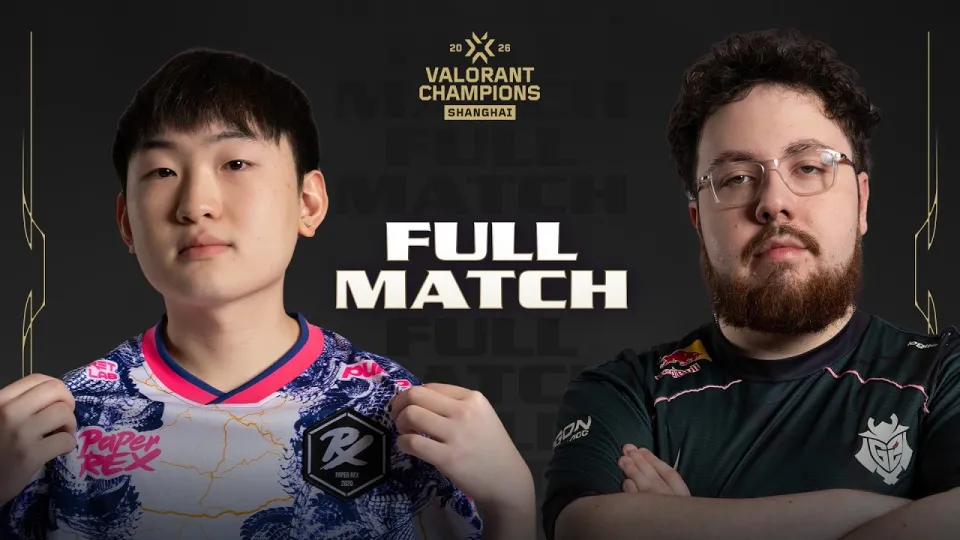
Video: PRX vs. G2 — FULL MATCH — VALORANT Champions Shanghai — Group Stage
Need articles like this for your video? They help promote it on YouTube and Google — order them in the Telegram bot @sat_sit_bot. It writes articles around your video, embeds the video and publishes them on popular niche websites (no ads). Free trial — 50 articles.
· based on the channel VALORANT Champions Tour
PRX vs G2 is the kind of VALORANT match that answers the question every fan asks before a big group-stage series: can two teams with contrasting styles stay close for three maps without either side running away with it? The full match, published by the VALORANT Champions Tour on 29 September 2026, shows PRX and G2 trading map wins, forcing a decider, and settling it on execution rather than star power alone. For schedule updates, bracket news, and official announcements around the event, the tournament's Twitter/X account is the fastest place to follow along.
What VALORANT Champions Shanghai is and why this group-stage match matters
VALORANT Champions Shanghai is the final and biggest trophy of the competitive season, and it runs from 24 September to 18 October. Sixteen teams qualify from four regions — Americas, CN, EMEA, and Pacific — and only one leaves as the 2026 VALORANT World Champion.
The tournament arrives after a season in which the established order was repeatedly tested: new contenders emerged, expectations were broken, and Masters produced a new champion twice. That context turns every group-stage series into a seeding fight, because a single loss can decide whether a team enters the playoffs on the upper or lower side of the bracket.
PRX and G2 sit on opposite ends of that story. PRX are the aggressive, tempo-driven roster that wants fights early and often; G2 are the structured, default-heavy team that wins by trading efficiently and forcing opponents into bad retakes. When those two philosophies meet, the series usually comes down to which team can impose its pace on the opponent's map pick.
Map one on Haven and the d4v41 carry
Haven set the tone because it rewards exactly what PRX do best: fast rotations through three sites and constant pressure on the mid window. The map also punishes hesitation, and G2's slower defaults gave PRX the openings they needed to take early map control.
The standout performer was d4v41, who effectively carried the team on Haven. His value came less from raw kill counts and more from timing — taking duels right as G2 committed to a site, which turned even rounds into clean post-plant setups. On Haven specifically, that meant:
- Winning the mid-window duel to split G2's rotations between A and C.
- Holding the retake angle on C long enough for the rest of the roster to collapse.
- Converting man advantages into planted spikes instead of chasing extra kills.
G2's response was readable but not always executable: they tried to slow the pace, stack the site PRX were least likely to hit, and win the series through utility. Against a team that thrives on chaos, that plan only works if every retake is clean.
Split and Trent's near-perfect performance
Split is the map where G2's structure should have paid off, and it largely did — but the story of the map was Trent, who looked like a complete player across every phase of the round. His impact showed up in three places at once: entry timing on attack, anchor discipline on defense, and mid-round calls that kept G2 from ever settling into a comfortable setup.
Against a disciplined opponent, Split usually becomes a utility war over mid and the A main choke. Trent's ability to win those small exchanges gave his team the freedom to play the map on their terms. For viewers learning the map, this is the most instructive part of the series: watch how often the winning team takes space first and asks questions later, rather than waiting for a perfect execute.
The decider map and the moments that flipped it
The third map turned the series into a genuine coin flip, and that is where the individual performances became decisive. Invy popped off on the decider, winning the kind of multi-kill rounds that erase a deficit in a single buy. Those rounds matter more than they look on a scoreboard, because they force the opposing team to change its economy and, often, its entire approach on the next buy.
The most talked-about moment came late, when Something nearly closed out a round before the Odin came out. It is a small detail with a large lesson: in a deciding map, players reach for unconventional weapons when standard rifles are not producing results, and that gamble can swing a round in either direction. The series also featured a visible misplay from Something earlier, the kind of aggressive peek that looks brilliant when it lands and costly when it does not — a reminder that PRX's style carries built-in variance.
Production notes and the questions viewers actually asked
The broadcast itself generated as much discussion as the gameplay. Two moments stood out in the chat:
- An audio cut around the 1:45:22 mark, which left viewers unsure whether they had missed a callout or a round transition.
- A brief on-screen appearance of Vitality and LOUD graphics early in the stream, which prompted questions about whether other matches were being promoted during the PRX vs G2 broadcast.
Neither issue changes the result, but both are worth knowing before you watch the full match, so you do not assume your stream is broken. The rest of the production held up well, and the match itself was widely described as entertaining from start to finish.
How to watch PRX vs G2 like a coach instead of a fan
A full-match VOD is most useful when you watch it with a specific question in mind. For this series, three questions produce the most value:
- On Haven, track where PRX take their first duel of each round. Their entire attack structure depends on winning that opening exchange.
- On Split, watch how G2 set up their mid control before every execute. When they lose mid, their site hits become predictable.
- On the decider, note every round where a single player's multi-kill decides the outcome, then ask what the opposing team could have traded differently.
If you play ranked, the practical takeaway is simpler: PRX win rounds by taking space early and forcing reactions, while G2 win rounds by denying space and forcing mistakes. Both approaches work, but only if your team commits to one of them consistently instead of switching mid-round.
Useful links
- Twitter/X: https://twitter.com/ValorantEsports
- Facebook: https://www.facebook.com/ValorantEsports/
- Instagram: https://www.instagram.com/VALORANTESPORTS/
- TikTok: https://www.tiktok.com/@valorantesports
- Twitch: https://www.twitch.tv/valorant
What the series leaves behind
PRX vs G2 was a group-stage match that played like a playoff series, and that is exactly why it is worth a full watch rather than a highlight reel. Haven showed how PRX convert tempo into map wins, Split showed how close Trent is to a complete player, and the decider showed how quickly a series can turn on one multi-kill or one questionable weapon choice. The result also matters for the bracket: in a sixteen-team field drawn from Americas, CN, EMEA, and Pacific, every group-stage win changes which side of the playoffs a team lands on. The VALORANT Champions Tour channel produced the full-match coverage and remains the best source for the rest of the Shanghai run — follow ValorantEsports on Twitter/X for schedules, results, and official updates as the tournament moves toward the 18 October final.
Key takeaways
- PRX and G2 met in the group stage of VALORANT Champions Shanghai, with the full match published by the VALORANT Champions Tour channel on 29 September 2026.
- The event runs 24 September to 18 October and gathers sixteen teams from Americas, CN, EMEA, and Pacific to crown the 2026 world champion.
- Haven and Split shaped the series: d4v41 carried on Haven while Trent looked close to a complete player on Split.
- A third map turned into the decider, with Invy popping off and Something nearly stealing a late round before the Odin gamble.
- Viewers flagged production details too: an audio drop near the 1:45:22 mark and a brief on-screen appearance of Vitality and LOUD.
Questions & answers
Did PRX or G2 win the group-stage match at VALORANT Champions Shanghai?
The full match was published by the VALORANT Champions Tour on 29 September 2026 and went the distance, with Haven and Split split between the teams before a decider map. The series was close enough that individual rounds — Invy's multi-kills on the third map and a late Odin gamble — shaped the final result. Watch the VOD for the exact scoreline, since group-stage results also affect playoff seeding.
Why did something pull out the Odin in the deciding map?
The Odin appears when a team needs to break a structured setup without winning clean rifle duels. It is a high-risk choice: it can shred a stacked site through walls and smokes, but it leaves the user vulnerable in open duels. In a decider, that trade-off often feels worth taking because a single round can end the series.
Was there an audio problem during the PRX vs G2 broadcast?
Viewers reported an audio cut around the 1:45:22 mark of the stream, which briefly made it unclear whether a round transition or a callout had been missed. It was a production issue rather than a gameplay one, and the match continued normally afterward. If you rewatch the VOD, expect a short gap there.
What can ranked players take from this VALORANT match?
The clearest lesson is commitment: PRX win by taking space early and forcing reactions, while G2 win by denying space and punishing impatience. Pick one approach per round and execute it as a team instead of switching mid-fight. Also study how both teams convert man advantages into planted spikes rather than chasing extra kills.
Source: PRX vs. G2 — FULL MATCH — VALORANT Champions Shanghai — Group Stage · Markdown version